Apr 17, 2026
•7 minutes read
•Author: MINDBODYFACE
When Natural Skincare Methods Can Do More Harm Than Good

Nowadays, information about at-home skincare is available to everyone. And so it’s the right time to talk about the risks associated with natural skincare methods. Many people already know that injectable treatments and surgery don’t solve all anti-aging problems and can be harmful. Faceplastica is becoming a trend in the fight against aging, as the technique can be learned and practiced on your own.
The key to safe,holistic skincare lies in understanding which cosmetic products to avoid and what can replace them without losing effectiveness. For example, coffee grounds, lemon juice, or baking soda are no gentler than professional aggressive peels. They cause microtrauma and increased sensitivity to UV rays. As a result, instead of cleansing, you’ll end up with irritated skin, hyperpigmentation, and flaking.
It’s also quite easy to make a serious mistake during a facial massage – the kind you might have seen on social media – if you ignore your individual characteristics and focus on just one area. Trigger points, without proper training, can cause spasms and micro-tears in collagen fibers.
The greatest risk is experimenting on your face without knowing the diagnosis and without sufficient training. Natural methods are not about prevention, but about deep work based on an understanding of anatomy and knowledge of root causes. A mindful approach to rejuvenation will not only yield long-lasting results but also ensure safety and confidence in the methods used.
Understanding the risks associated with natural facial rejuvenation methods
It is important to understand that “natural” does not equal “safe.” Here are some skincare methods that harm the skin:
- Lemon juice, vinegar, carbonated water
They are used for their skin-lightening effects, but these products have extremely low pH levels, which destroy the skin’s protective barrier, leading to dehydration and photosensitivity in the sun.
- Baking soda
Used as a scrub, it has a fairly high acidity, which causes irritation and creates an environment for bacterial growth.
- Pure essential oils
You should be careful with these, as they are highly concentrated compounds that can cause dermatitis and allergies.
- Excessive use of facial massage
Improper technique can not only undo all the work you’ve done but also damage the tissues. By stretching the skin instead of deeply penetrating the tissues, the fibers suffer microtears and exacerbate sagging. Applying strong pressure to the cheek area damages subcutaneous structures, causing swelling and impaired microcirculation.

To avoid side effects from facial care products, it is essential to consult a specialist in natural rejuvenation. It is important to consider the individual’s overall health and personal characteristics, which have been identified through body and facial diagnostics.
Common mistakes in facial massage and their consequences
Facial massage is one of the most powerful tools for reducing swelling, eliminating toxins, and lifting the face. However, it can become a source of problems if techniques are performed without considering the body’s nuances. Let’s examine the main mistakes in self-facial massage that affect the condition of the skin and the results of the techniques:
Mistake 1: Applying excessive pressure to the tissues
Pinching or rubbing can damage the skin, subcutaneous fat, and blood vessels, leading to bruising, swelling, and muscle hypertonicity.
Mistake 2: Facial tension due to improper technique
Not all techniques are suitable for everyone, so a lack of understanding of the effects or physiology can harm the face and lead to worsening ptosis, the formation of new wrinkles, muscle spasms, and pain.
Mistake 3: Frequency and duration
Tissues need time to recover, as any facial manipulation is stressful. The skin and muscles do not have time to recover, leading to microtraumas and inflammation. As a result, elasticity is lost, muscle fatigue sets in, and the skin becomes saggy.

Unsafe methods of natural skin care lead to premature aging and loss of tone. Your movements should be gentle and precise to reduce spasms and improve tissue structure. Quality, not quantity of repetitions, is important so that the result is not just quick but long-lasting.
Skincare methods that can damage the skin
Which methods damage the skin barrier and cause premature aging:
- Harsh scrubs – alcohol-based toners, alkaline soap, and stiff brushes – lead to microtrauma, damage the skin’s protective barrier, and cause allergies, flaking, oily shine, and clogged pores.
- Overuse of active ingredients – retinol, vitamin C, and acids – can be harmful if used without proper preparation or mixed with other ingredients in the wrong proportions. The skin becomes vulnerable to sunlight, leading to hyperpigmentation and early wrinkles.
- When facial exercises backfire: dynamic exercises cause muscles to contract actively, which can lead to hypertrophy and deeper wrinkles if facial anatomy isn’t taken into account.
- Neglecting UV protection: without SPF creams, the skin ages faster, collagen and elastin break down, and hyperpigmentation appears.
Choose gentle skincare, and approach facial exercises mindfully and with the necessary knowledge to restore health and naturally rejuvenate your face.
Risks of performing facial exercises incorrectly
You can’t just “pump up” your face like a bicep, since every muscle depends on connective tissues, bones and has a specific structure and contours.
The main risk is associated with improper facial exercises. For example, applying body fitness principles to the face. High-rep exercises lead to excessive growth of the facial muscles, which begin to pull the corners of the mouth. It leads to “marionette lines,” sagging skin, “crow’s feet,” asymmetry, and horizontal creases.
The ineffectiveness of facial exercises lies in the fact that the muscles do not relax but instead create even stronger contractions and deeper wrinkles. This disrupts blood circulation, causes swelling, and worsens complexion and lymphatic flow. But the most pronounced problem is asymmetry. Excessively intense facial exercises lead to the two sides of the face looking different, as the more developed side will begin to look more massive than the other.
Safe facial rejuvenation methods are possible after completing training at the Faceplastica Academy or consulting with a specialist. In this case, you will be equipped with the necessary knowledge to create a lifting effect, work with tissues at a deep level, and strengthen the “framework” as well as the neck and back muscles without harming your health. It is important to study anatomy or trust a specialist who will teach you safe rejuvenation methods for use at home.
How to Avoid Overtreatment
Lasting results are achieved not by those who do more, but by those who do it right. But how can you avoid overdoing your skincare routine while still achieving skin repair and rejuvenation? Self-care should be supportive, not disruptive, and should not create a dependency on treatments.
The foundation of safe practices:
- The “less is more” principle
Perform massage and exercises 3–4 times a week for 15 minutes each, but with thorough tissue work. This will help avoid stress and microtrauma to the muscles. Apply acids once a week and monitor the reaction to avoid damaging the skin.
- Strength does not equal effectiveness
During the massage, try to apply light pressure on the muscles, but without pain or discomfort. If red marks or pain remain after the procedure, the technique was performed incorrectly.
- Mindfulness over autonomy
It’s important to address the cause, not the effect, of changes. Pulling the skin to smooth out wrinkles isn’t the answer. Instead, gently work on problem areas along the lymphatic flow: toward the temples, behind the ears, and toward the collarbones, avoiding erratic movements.

The body always provides feedback, so you’ll be able to notice warning signs in time:
- Facial inflammation due to treatment
- Unusual dryness or tightness of the skin
- Increased swelling
- Increased sensitivity to your usual products
These signs indicate that you need to pause for a few days and give your skin time to recover.
If you notice these signs, stop. Return to your basic skincare routine for 5–7 days to allow your skin to recover. Rejuvenation begins with listening to your own body. Safe methods will not compromise the effectiveness or health of your skin if you trust your instincts by understanding your body’s physiology.

UNEVEN SMILE: WHY ONE SIDE OF THE MOUTH SITS HIGHER AND WHAT FACIAL TENSION HAS TO DO WITH IT
An uneven smile can be one of those details you only notice in photos or videos. One corner of the mouth lifts more. One side of the upper lip looks higher. One cheek seems to move first, while the other appears quieter or tighter. A little facial asymmetry is normal. Almost no one has a […]
Author:MINDBODYFACE
 7
7 0
0
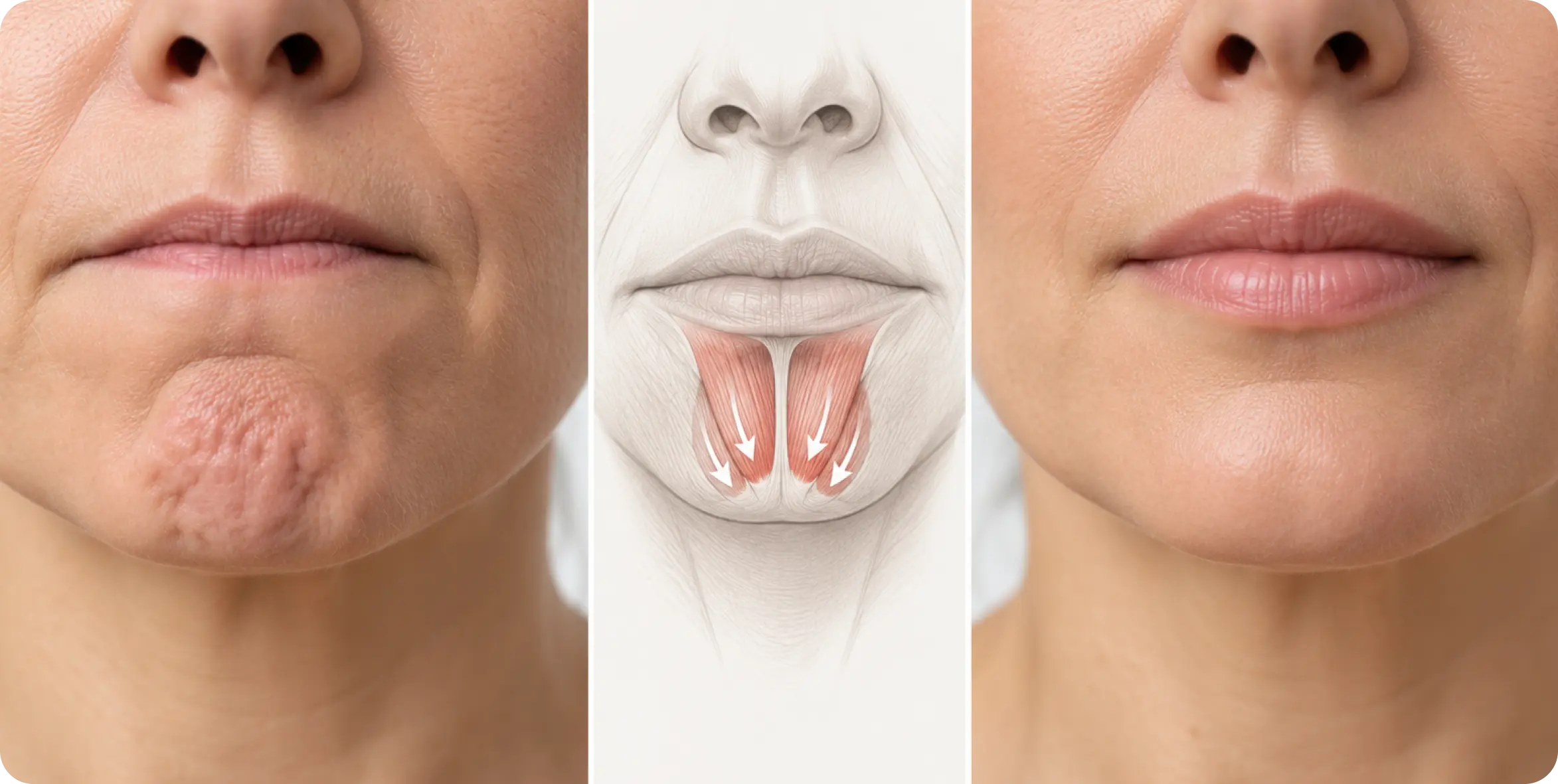
DIMPLED CHIN AND MENTALIS TENSION: WHY THE CHIN LOOKS UNEVEN AND HOW TO RELAX IT
A dimpled chin can make the lower face look tense even when you are not upset. The skin may appear bumpy, gathered, or uneven when you talk, smile, concentrate, swallow, or press your lips together. For some people, this texture appears only during expression. For others, it remains visible at rest. The common reason is […]
Author:MINDBODYFACE
80
HOLLOW TEMPLES: WHY TEMPLES LOSE VOLUME AND HOW FACIAL AGING CHANGES THIS AREA
Hollow temples are the indentations that can appear at the sides of the forehead, between the outer eyebrow, hairline, and upper cheekbone. Temple hollowing can make the upper face look narrower, more angular, or more tired—even when your skin is smooth and your cheeks still have volume. This area is easy to overlook. People often […]
Author:MINDBODYFACE
160
LIP LINES AND SMOKER’S LINES: CAUSES AND NATURAL WAYS TO SOFTEN THEM
Lip lines are the fine vertical creases that appear on and above the upper lip. They are often called smoker’s lines, but smoking is only one possible cause. Sun exposure, natural skin aging, repeated mouth movements, dryness, genetics, and changes in the tissues around the mouth can all make vertical lip lines more visible. These […]
Author:MINDBODYFACE
120


MINDBODYFACE LLC
1021 E Lincolnway Suite 8342, Cheyenne, WY 82001
+16282892382
All services and information on this website are for educational purposes only and do not constitute medical advice or treatment -